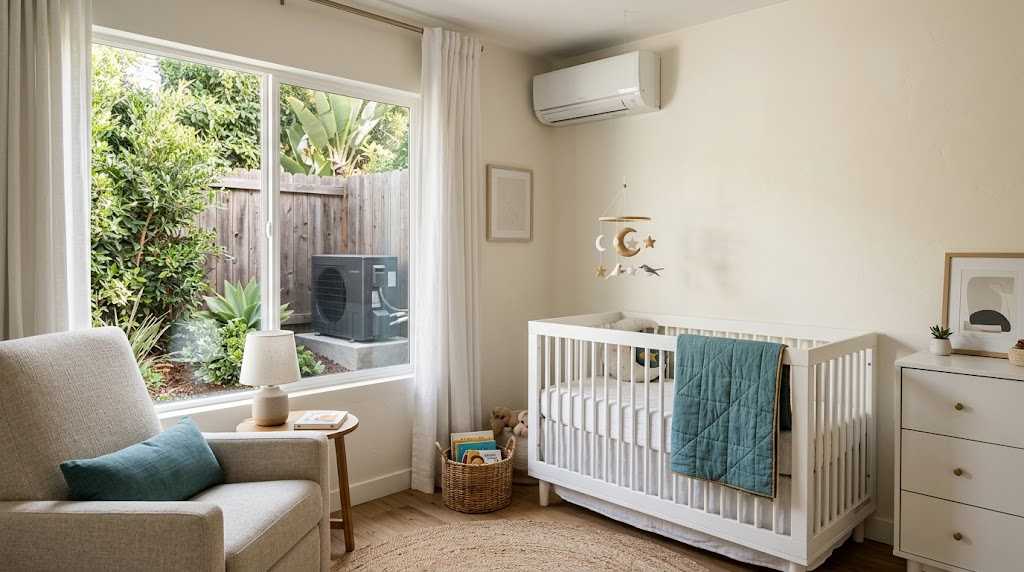
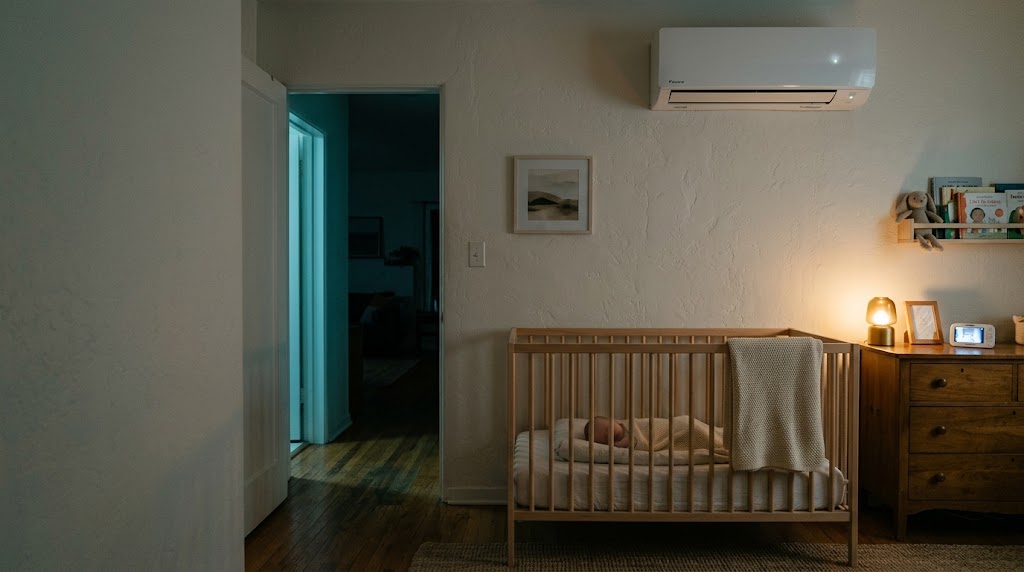
A heat pump is an electric heating and cooling system that moves heat instead of making it. In summer it carries heat out of the room, the way an air conditioner does. In winter it runs in reverse and brings heat in from the outdoor air. One unit does both jobs, and nothing burns inside the house.
If you have looked into cooling a nursery, you have probably already seen one: almost every ductless mini split sold today is a heat pump. South Coast AQMD, the air district for most of Los Angeles, describes heat pumps as up to three to four times more efficient than traditional gas systems. Here is what that means for a child’s room, which type fits which home, and when a rebate applies.
Key takeaways
- One unit, two seasons. A heat pump heats and cools the same room, so a nursery needs one system, not an air conditioner plus a space heater.
- It moves heat rather than burning fuel, which is why it delivers more heat than the electricity it uses.
- Four types fit LA homes: ductless mini split, ducted, window, and heat pump water heaters for hot water.
- For a single room, a ductless mini split is usually the fit. It is quiet, holds a set temperature, and needs no ducts.
- The GO ZERO rebate pays only when a heat pump replaces gas or propane. A unit added to a room that never had gas heat does not qualify.
How a heat pump works
A heat pump circulates refrigerant between an indoor coil and an outdoor unit. The refrigerant soaks up heat where it is not wanted and lets it go where it is. A part called a reversing valve flips the direction, which is the whole difference between a heat pump and a cooling-only air conditioner.
- Absorb. Cold refrigerant picks up heat from the air passing over a coil, even on a cool night.
- Compress. The compressor squeezes the refrigerant, which makes it much hotter.
- Release. The hot refrigerant gives off its heat at the other coil, and a fan moves that air into or out of the room.
- Reverse. In summer the cycle runs the other way and the unit cools the room.
Efficiency is measured as the coefficient of performance, or COP: heat delivered divided by energy used. A gas furnace or an electric space heater can never deliver more heat than the energy it consumes. A heat pump can, because it is moving heat that already exists outdoors. That advantage is largest in mild weather, which describes most of a Los Angeles winter.
Which type fits a child’s room?
| Type | How it works | Where it fits a nursery |
|---|---|---|
| Ductless mini split | A wall, ceiling or floor head in the room, connected to a small outdoor unit | The usual fit for one room: an upstairs nursery, a converted office, a room the central system never reaches |
| Multi-zone mini split | One outdoor unit feeding heads in several rooms | Homes without ducts that want the nursery and the main bedroom on separate settings |
| Ducted heat pump | Replaces a gas furnace and central AC, using the existing ducts | Whole-home replacements where the nursery is already comfortable on the central system |
| Window heat pump | Sits on the sill and plugs into a standard outlet | Renters and short-term setups; louder in the room than a mini split head |
| Heat pump water heater | The same cycle, heating a water tank | Replacing a gas water heater in the garage; it does not heat or cool the room |
For a closer look at the most common nursery setup, read how mini splits work and which kind belongs in a child’s room. For the window option, see mini split vs window unit for a nursery.
What matters most in a nursery
Sound
The indoor head of a mini split heat pump is one of the quietest ways to heat and cool a room. Some Mitsubishi Electric wall units are rated as low as about 20 dB(A) on their quietest fan speed. The rating is measured in a lab, so placement matters too: a head aimed away from the crib and a unit that is not oversized will stay at its lower speeds. More in are mini splits loud?
A steady temperature
Inverter heat pumps slow down instead of switching fully on and off, which keeps the room close to the setting through the night. That only works when the unit is sized for the room. An oversized one cools fast, stops, and lets the room drift. See what size mini split a child’s room needs and what temperature a baby’s room should be.
Humidity and filtration
A correctly sized heat pump removes moisture as it cools. Its built-in screen protects the coil, but the EPA notes that ductless units generally do not filter fine particles, so filtration is a separate decision. Our guides to baby room humidity and choosing an air purifier for a nursery cover both.
Heat pump rebates in Los Angeles
South Coast AQMD’s GO ZERO program pays homeowners to switch from gas or propane to a heat pump. In Phase 2, which opened to single-family homes on November 6, 2026, the rebate is $500 for a heat pump heating and cooling system under 3 tons, and $1,000 for 3 tons or more. Homes in state-designated overburdened communities receive double. The installation must be on or after September 4, 2026, and the permit must be finalled.
| Nursery situation | GO ZERO rebate? | Why |
|---|---|---|
| Mini split replacing a gas wall furnace in the room | Yes, under the under-3-ton tier | The heat pump replaces gas heating |
| Ducted heat pump replacing the home’s gas furnace and AC | Yes, usually the 3-ton-or-more tier | The heat pump replaces the gas furnace |
| Mini split added to a room heated by a central gas furnace that stays | No | No gas equipment is removed |
| Heat pump replacing only an air conditioner | No | GO ZERO pays only for replacing gas or propane |
For the full rules, the water heater rebate and how to apply, read our GO ZERO heat pump rebate guide for Los Angeles nurseries.
Homes on LADWP power can also look at the LADWP Consumer Rebate Program, which pays per ton for qualifying heat pumps. Its application is written around whole-home systems, so a single-room install may not qualify. Confirm before you count on it. Our mini split cost guide covers prices and the other programs.
How Little Lungs chooses a heat pump
On a Free Air Check we log the nursery’s temperature and humidity at the crib and look at how the room is heated now, including whether there is gas equipment a rebate could replace. In Nursery Climate Design the heat pump is sized to that one room with a load calculation, and its placement is planned around the crib. After the Certified Install we measure the room again and give you the readings in writing.
Questions parents ask
What is a heat pump in simple terms?
An air conditioner that can also run in reverse. It moves heat out of the room in summer and brings heat in from outdoors in winter, using electricity instead of gas.
Is a mini split a heat pump?
Almost always. Nearly every ductless mini split sold today is a heat pump, so the same wall unit heats and cools the room. A heat pump can also be a ducted system or a window unit.
Is a heat pump quiet enough for a nursery?
The indoor unit of a well-chosen mini split heat pump is one of the quietest ways to heat and cool a room. Some Mitsubishi Electric models are rated as low as about 20 dB(A) on their quietest fan speed. Placement and sizing matter as much as the rating.
Does a heat pump in one room qualify for the GO ZERO rebate?
Only if it replaces a gas or propane furnace or water heater. A heat pump added to a room that never had gas heat, or one that replaces only an air conditioner, does not qualify.
Do heat pumps work in a Los Angeles winter?
Yes. Heat pumps work best in mild weather, and Los Angeles winters are mild, so one sized for the room can keep it steady through the coldest nights of the year.
Find out what their room needs
We’ll measure the nursery, check what heats it now, and tell you plainly whether a heat pump, and a rebate, fit.
Sources
- South Coast AQMD — GO ZERO Incentive Program and GO ZERO FAQ (Phase 2 amounts and eligibility)
- South Coast AQMD — GO ZERO re-opening announcement, August 2026 (efficiency compared with gas systems)
- U.S. Department of Energy — Heat pump systems
- U.S. Environmental Protection Agency — Guide to Air Cleaners in the Home