Aim for a relative humidity below 60 percent, ideally between 30 and 50 percent. That is the U.S. EPA's guidance for indoor air in homes, and it is the best published range to use for a baby's or toddler's room. The number to watch in Los Angeles is usually the top of that range, not the bottom: a closed nursery on a muggy coastal night drifts high far more often than it dries out.
Most advice online gives a single figure and stops. Here is where the numbers come from, why "40 to 60 percent" and "30 to 50 percent" are both quoted, how to measure the room at the crib, and what actually holds humidity steady.
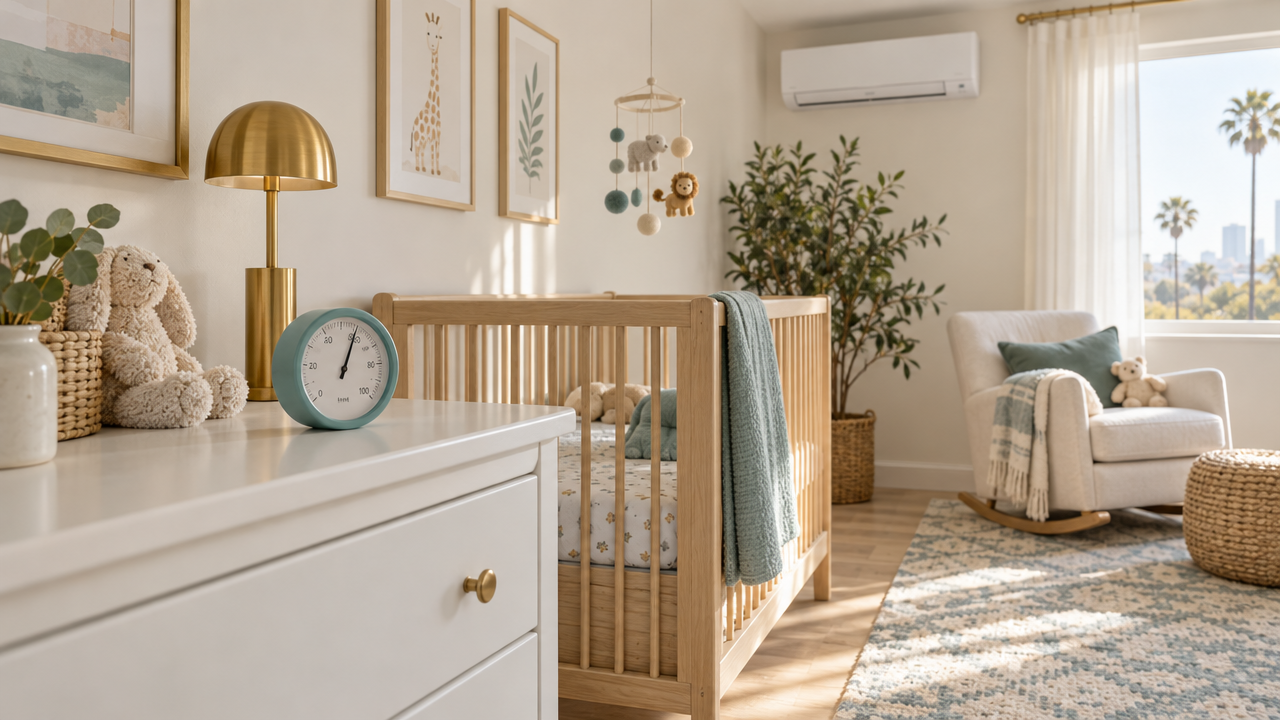
Relative humidity is the share of water vapor the air is holding compared with the most it could hold at that temperature. Here is how to read a number from the hygrometer in the nursery.
| Reading | How it compares with EPA guidance | What to do |
|---|---|---|
| Below 30% | Below the ideal range | The air may feel dry. Check for a cause, such as a Santa Ana wind day or heating running. Add moisture gently and re-measure. |
| 30–50% | EPA's ideal range | Nothing to change. |
| 50–60% | Under the EPA ceiling, above the ideal | Acceptable. If it stays here overnight, look at ventilation and cooling. |
| Above 60% | Above the EPA's recommended maximum | Find and reduce the moisture source. The EPA recommends an air conditioner or dehumidifier when needed, and drying wet surfaces quickly. |
Source: U.S. EPA, A Brief Guide to Mold, Moisture and Your Home. The guidance is for homes in general and does not give a separate range for children's rooms.
Many parenting sites quote 40 to 60 percent. The EPA's home guidance is below 60 percent, ideally 30 to 50 percent. They are not in conflict, they simply describe different edges. If you want one target, 40 to 50 percent sits inside both, and it keeps a margin under the 60 percent line.
The same range applies to a toddler's room. Nothing in the EPA's guidance changes with age. What changes is the room itself: more fabric, more activity, and often a humidifier brought in during a cold.
Humidity in a Los Angeles nursery depends more on location and ventilation than on the season.
The EPA recommends using an air conditioner or dehumidifier when needed, and venting moisture-producing appliances outdoors where possible. In a nursery, the cooling system is usually the better tool, and its size decides how well it works. ENERGY STAR notes that an oversized air conditioner cools a room quickly without running long enough to remove much moisture, which can leave the air damp and clammy. That is one more reason a single room needs a unit sized for that room. We walk through the numbers in what size mini split a child's room needs.
Confirm it with the hygrometer first, then add moisture a little at a time and re-measure. If you use a humidifier, follow the manufacturer's cleaning and water instructions, keep it off the floor next to the crib, and stop when the reading reaches the middle of the range. The aim is 30 to 50 percent, not as high as the unit will go.
The two interact. A room that holds a steady temperature usually holds a steadier humidity. Our baby room temperature guide covers the temperature half.
On a Free Air Check we log the room's temperature and relative humidity at crib height and note what is adding or removing moisture.
In Nursery Climate Design, the room's load and the unit's output are matched so it runs long enough to dehumidify, and the air and humidity plan is written into the scope.
After the Certified Install, we read the relative humidity in the room against the EPA's guidance and give you the reading in writing.
The EPA recommends keeping indoor relative humidity below 60 percent, ideally between 30 and 50 percent. That guidance is for homes in general, so it is the best published range to aim for in a baby's room. Many parenting sites quote 40 to 60 percent; the overlap of the two is 40 to 50 percent.
Yes, it is above the EPA's recommended ceiling of 60 percent for indoor relative humidity. The EPA notes that condensation can be a sign of high humidity and recommends drying wet surfaces quickly and using an air conditioner or dehumidifier when needed.
Thirty percent is the bottom of the EPA's ideal 30 to 50 percent range, so it is not out of range, but the air may feel dry, especially during a Santa Ana wind episode. Measure the room before adding moisture, and avoid pushing it above 50 percent.
The same range applies. The EPA's indoor humidity guidance does not change with a child's age: below 60 percent, ideally 30 to 50 percent. What changes is the room, because a toddler's room often has more fabric, more activity and sometimes a humidifier.
Often not. Coastal Los Angeles air is usually moist enough that the more common problem is humidity that is too high in a closed room. Measure with a hygrometer at crib height for a few days at night and during the day before deciding. Inland neighborhoods and Santa Ana wind days can read drier.
Use a digital hygrometer, place it at crib height away from the window, the vent and any humidifier, and read it at several times of day. Consumer units vary in precision, so compare two if the number matters. A Free Air Check logs humidity in the room with the temperature.
In cooling mode, an air conditioner pulls moisture out of the air as it cools. A correctly sized unit runs long enough to do this. ENERGY STAR notes that an oversized unit cools the room quickly without removing much moisture, which can leave the air damp and clammy.
We'll log the temperature and humidity at crib height and tell you plainly whether anything needs to change.
Get Your Free Air CheckSources
Little Lungs describes comfort and room conditions, not medical outcomes. Talk to your pediatrician about your child's health.