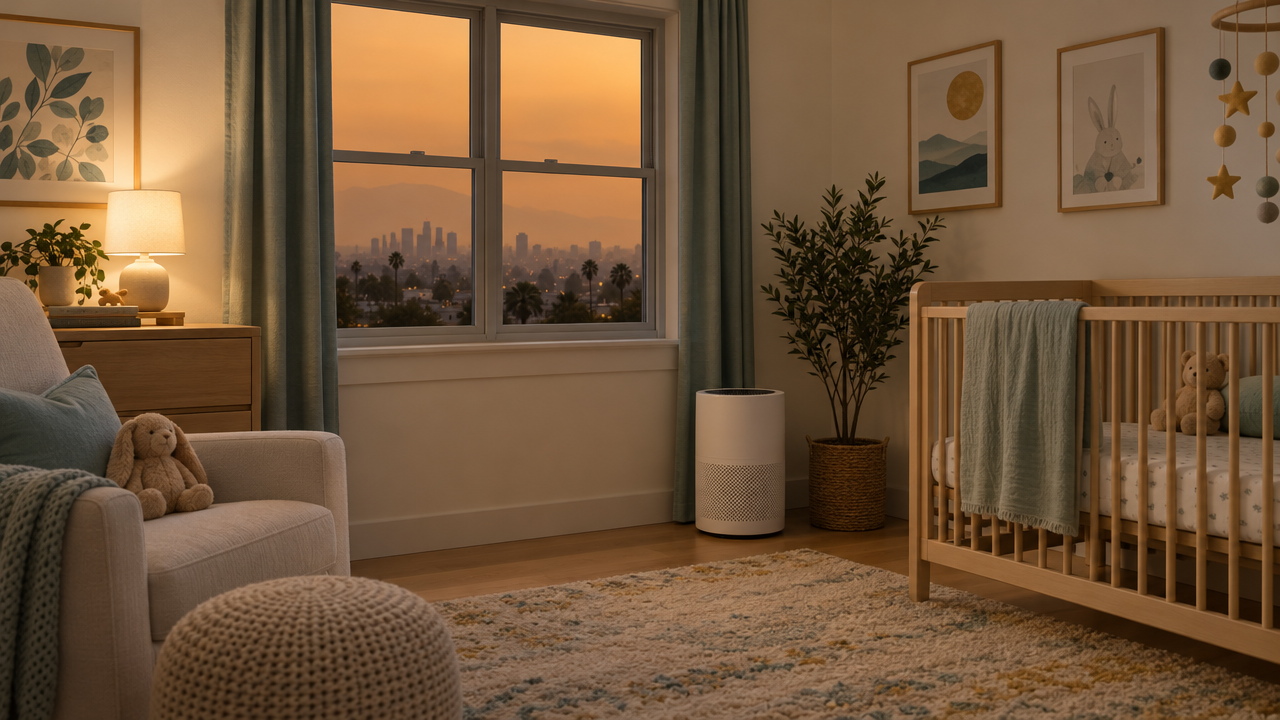
Close the windows and doors, stay cool with the air conditioning, and run a right-sized, CARB-certified portable air cleaner in the nursery on its highest speed. That is the short version of the EPA's guidance for a smoke event. The part most Los Angeles parents get wrong is the mini split: it keeps the room cool with the windows shut, but the EPA says ductless mini splits generally do not filter fine particles.
This guide puts the steps in order, explains what a mini split does and does not do on a smoke day, and shows how to choose an air cleaner that is legal to sell in California and sized for a small room.
| Step | What to do | Where it comes from |
|---|---|---|
| 1. Close up | Keep windows and doors closed during the smoke event. Use air conditioning or fans to stay cool. | EPA, Wildfires and Indoor Air Quality |
| 2. Set the system | If your system has an outdoor air intake, switch it to recirculate or close the damper. Run the fan continuously so more air is filtered. | EPA |
| 3. Add a portable air cleaner | Choose one sized for the room and run it on its highest speed as often as possible, placed where people spend the most time. | EPA |
| 4. Check it's legal and ozone-free | In California, look for the CARB certification label and find the model on CARB's list. | CARB |
| 5. Keep the filter fresh | Change the air cleaner's filters when they look dirty. | EPA |
| 6. Open up carefully | Open windows only when outdoor air improves, even briefly, to air out the room. | EPA |
Check your local air quality index before you open up. AirNow's airnow.gov publishes current readings.
A standard wall-mounted mini split recirculates the air that is already in the room. That is the useful part: you can keep the windows closed and still keep the room cool, which is exactly what the EPA advises.
The filter is a different matter. The EPA states that ductless mini-split heat pumps generally do not filter fine particles in the air passing through them. The filters typically installed are designed to protect the equipment from large particles like pet hair and lint. The EPA also notes that a mini split mainly filters the air in the room where it is installed, and only while it is running.
Some mini-split products claim higher-efficiency filters. The EPA's advice is to verify that the filter is rated MERV 13 or higher and fits snugly, with no bending or crushing to make it fit. If your unit does not have a MERV 13 or higher filter, or you are unsure, the EPA suggests using a portable air cleaner.
| Check | Why it matters |
|---|---|
| Sized for the room | The EPA advises choosing a unit sized for the room where it will be used. A nursery is small, so a unit rated for a much larger room is usually more than it needs. |
| On CARB's certified list | Since 2010, air cleaners sold in California have had to be certified. Electronic air cleaners must also pass an ozone test with a limit of 0.050 parts per million. |
| Does not make ozone | The EPA says to make sure the unit does not produce ozone. CARB's rule exists because some air cleaners generate ozone, some on purpose. |
| Clean air delivery rate is stated | The EPA notes that commercial air cleaners with a known clean air delivery rate are typically preferred over homemade ones. |
| Sound on high | The EPA advises running it on the highest speed, so the high-speed sound is the one that counts. Check it in the room, and keep it away from the crib. See how loud mini splits are in a baby's room for how to read a decibel rating. |
To check a model, find its model number on the rating plate, look for the CARB label on the box, and search CARB's list of certified air cleaning devices.
The EPA describes attaching one or more furnace filters to a box fan with tape, brackets or bungee cords. It also says commercial air cleaners with a known clean air delivery rate are typically preferred. If you build one while you wait for a proper unit, keep it away from the crib and from any cord a child could reach.
A closed room also holds its moisture. Our baby room humidity guide shows how to check it.
On a Free Air Check we look at how the room is cooled, what filter the system has, and where an air cleaner would sit.
In Nursery Climate Design, the air plan is written into the scope: the filter the system allows and a sized, CARB-certified portable cleaner where one is needed.
After the Certified Install, we confirm that what was specified is what is installed and set up, and hand you the record.
Keep windows and doors closed during the smoke event and stay cool with air conditioning or fans, as the EPA advises. Run a portable air cleaner sized for the room, on its highest speed, placed where the child spends the most time. In California, choose one that is on the CARB list of certified air cleaners, which also limits ozone.
Generally not. The EPA says ductless mini-split heat pumps generally do not filter fine particles, because the filters typically installed protect the equipment from large particles like lint and pet hair. A mini split lets you keep the room cool with the windows closed. For fine particles, the EPA suggests a portable air cleaner unless the unit has a MERV 13 or higher filter.
Yes, to keep the room cool with the windows closed. The EPA says to keep windows and doors closed during a smoke event and use fans or air conditioning to stay cool. If a system has an outdoor air intake, set it to recirculate. A window air conditioner should have its outdoor air damper closed, or not be used if it cannot be closed.
The EPA advises a unit sized for the room that does not produce ozone, run on the highest speed as often as possible, with the filter changed when it looks dirty. In California, every air cleaner sold must be CARB certified, with an ozone emission limit of 0.050 parts per million, so check the model on CARB's list.
The EPA says to open windows and doors only when outdoor air improves, even briefly, to air out the house. Check your local air quality index before opening, and close up again if it worsens.
The EPA describes attaching one or more furnace filters to a box fan as an option, and notes that commercial air cleaners with a known clean air delivery rate are typically preferred. If you build one, use it as a stopgap and keep it away from the crib.
We'll look at how the room is cooled and filtered and tell you plainly what it needs.
Get Your Free Air CheckSources
Little Lungs describes comfort and room conditions, not medical outcomes. Talk to your pediatrician about your child's health.