To choose an air purifier for a nursery, check four things: a clean air delivery rate (CADR) big enough for the room, California Air Resources Board (CARB) certification, the sound rating at the speed you’ll actually run overnight, and a spot where air can move freely around it.
Most “best purifier for baby” lists start with brands. This one starts with the numbers on the box, because they decide whether the unit does anything in your particular room.
Key takeaways
- Size by CADR, not by the box’s room-size claim. AHAM’s 2/3 rule: smoke CADR at least two-thirds of the floor area in square feet.
- In California, look for CARB certification. Since 2010 every air cleaner sold in the state must be certified, with ozone emissions at or below 0.050 ppm.
- Avoid ozone generators. The EPA advises against them.
- Your air conditioner isn’t an air cleaner. The EPA notes room AC filters mainly protect the coil.
- Read the sound rating for the speed you’ll use. CADR is measured at the highest speed.
What size air purifier does a nursery need?
The industry rule of thumb comes from AHAM, the appliance manufacturers’ association that verifies CADR: the purifier’s smoke CADR should be at least two-thirds of the room’s floor area in square feet. Smoke CADR is the one to use because smoke particles are the smallest and hardest to catch.
| Nursery size | Floor area | Minimum smoke CADR (2/3 rule) |
|---|---|---|
| 10 × 10 ft | 100 sq ft | 67 |
| 10 × 12 ft | 120 sq ft | 80 |
| 12 × 12 ft | 144 sq ft | 96 |
| 12 × 14 ft | 168 sq ft | 112 |
The rule assumes an 8-foot ceiling. Taller ceilings mean more air to clean, so size up. And because CADR is measured at full speed, a unit you plan to run on low overnight should have headroom above the minimum.
What to look for on the box
- A verified CADR. Look for the AHAM Verifide mark, or a CADR figure tested to the AHAM standard.
- CARB certification. CARB keeps a public list of certified air cleaning devices. If a model isn’t on it, it can’t legally be sold in California.
- A mechanical filter. The EPA’s guidance centers on filters that physically capture particles. “True HEPA” filters are the common choice in portable units.
- No ozone. Skip “ozone generators” and anything marketed as producing “activated oxygen.” The EPA advises against them indoors.
- A published sound rating at each speed, plus a sleep or night mode that dims the lights.
Where to put it in the room
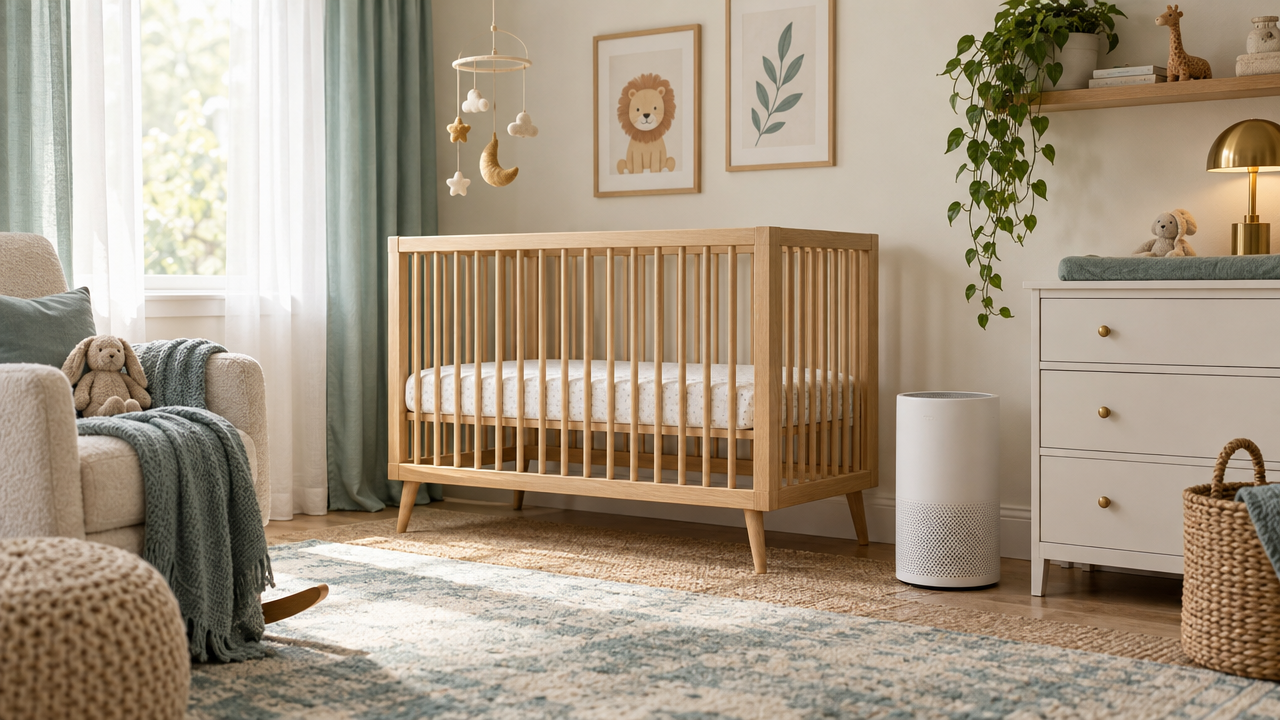
- Near the crib, not on it. A few feet away, with clear space around the intake and outlet.
- Out of reach, cord secured. Once a baby can pull up or crawl, the cord and the unit’s buttons become a hazard. Route the cord behind furniture.
- Not blowing on the baby. Aim the outlet across the room, the same rule as for a fan or an AC.
- Door and windows closed while it runs. A purifier can only keep up with the air in the room it’s in.
What a purifier can and can’t do
The EPA explains that portable air cleaners can reduce airborne particles in the room they’re sized for, and that they work best alongside two other things: removing the source where you can, and ventilating with clean outside air when it’s available. A purifier doesn’t capture particles that have settled into carpet or bedding, and it does nothing for temperature or humidity.
It also isn’t something your air conditioner does for you. The EPA notes the filters in room air conditioners mainly protect the equipment, and ductless mini splits are similar. We explain that trade-off in mini split vs window unit for a nursery. For the room’s climate, see what temperature a baby’s room should be.
Keeping it working
- Change filters on schedule. A clogged filter moves less air, so the CADR you paid for drops.
- Budget for filters before you buy. Replacement cost over a year can rival the purchase price.
- Vacuum the pre-filter if the model has one.
- Run it before bedtime on a higher speed, then drop it to the quiet setting overnight.
How Little Lungs approaches the air in a nursery
We treat climate and air as one design, not two purchases. On a Free Air Check we measure the room, note where air comes in and where it goes, and tell you whether a portable purifier is enough or whether the room’s system needs better filtration built in.
Questions parents ask
What size air purifier do I need for a nursery?
Use the AHAM 2/3 rule: the purifier’s smoke CADR should be at least two-thirds of the room’s floor area in square feet. A 120 sq ft nursery needs a smoke CADR of at least 80; a 150 sq ft room needs at least 100.
Is it safe to run an air purifier in a baby’s room?
A filter-based purifier that is certified by the California Air Resources Board is a common choice for a child’s room. The EPA advises against devices that produce ozone. Keep it out of the crib’s reach, off the crib itself, and with the cord secured.
Does a mini split or air conditioner clean the air?
Not meaningfully. The EPA notes that the filters in room air conditioners mainly protect the coil, and ductless mini splits are similar. Air cleaning is a separate decision.
How loud is an air purifier on its lowest setting?
It varies widely by model, so read the manufacturer’s sound rating for the speed you will actually use overnight, not the quietest number on the box. A purifier only delivers its rated CADR at its highest speed.
Want the room’s air looked at properly?
We measure the nursery and tell you plainly what would make the air feel cleaner, and what wouldn’t.
Sources
- U.S. EPA — Guide to Air Cleaners in the Home
- California Air Resources Board — California Certified Air Cleaning Devices
- AHAM — AHAM Verifide (CADR and the 2/3 rule)
This post covers room comfort and air. For questions about your child’s health, breathing or allergies, talk with your pediatrician.