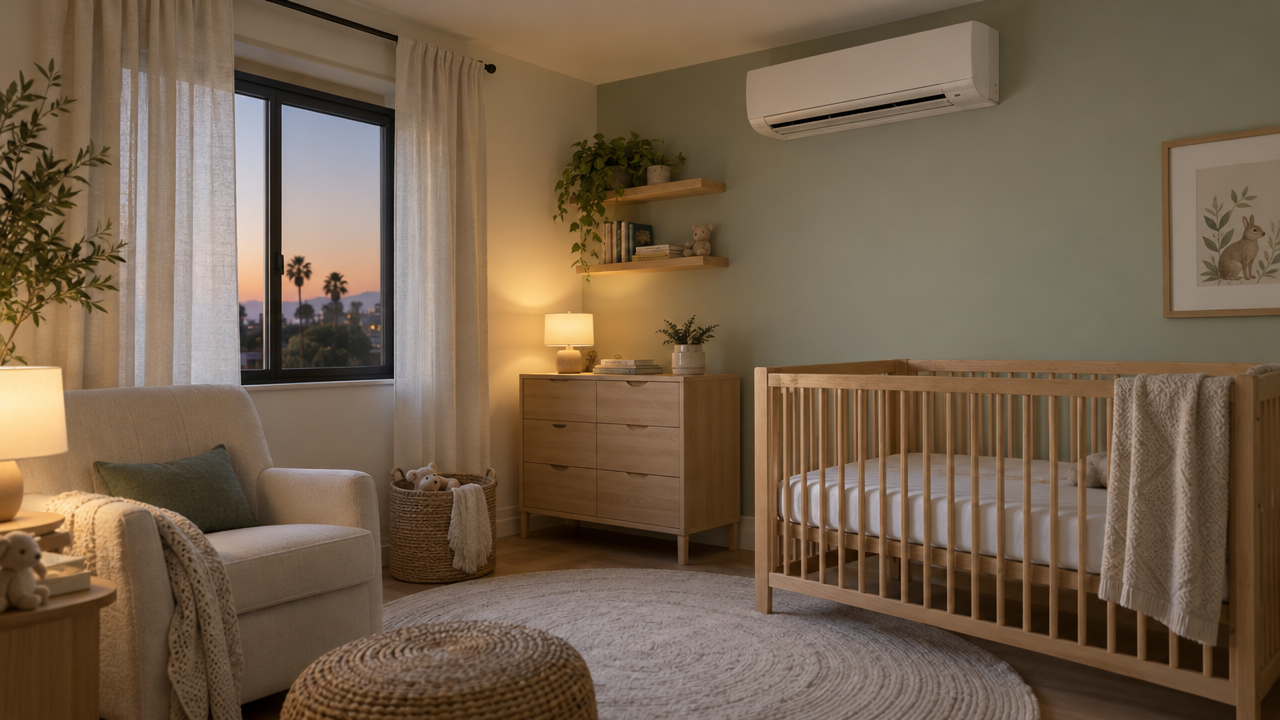
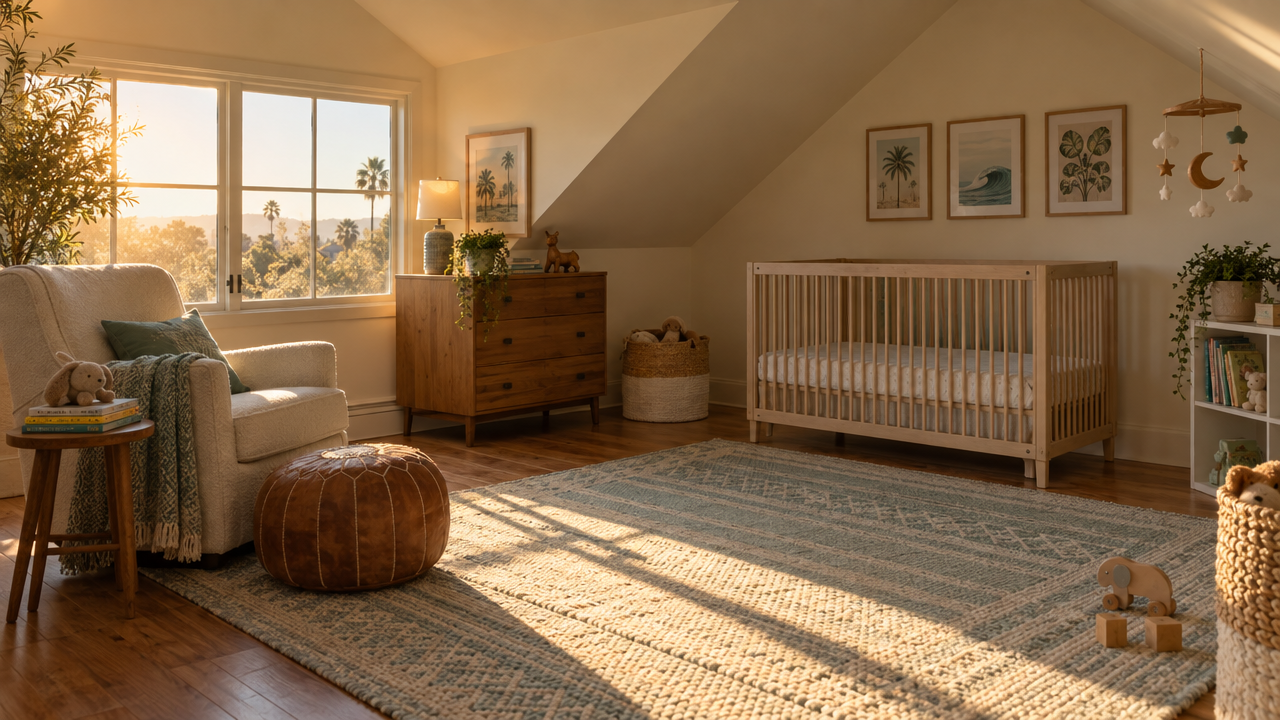
An upstairs nursery runs hot for three reasons that stack on top of each other: warm air rises inside the house, the roof stores the afternoon sun and releases it into the rooms below after dark, and the thermostat that runs the whole system is downstairs, where it’s already comfortable.
It’s the most common call we get from South Bay and Westside parents: the house is fine, but the room the baby sleeps in reads several degrees warmer at bedtime. Here’s how to find which cause is yours, and how to fix the one room without rebuilding the whole house’s system.
Key takeaways
- Measure first. Put a thermometer near the crib and one by the thermostat, and read both at bedtime. The gap is your real problem.
- The roof is often the biggest load. The U.S. Department of Energy notes radiant barriers are most effective in hot, sunny climates, which tells you how much heat comes down through the attic.
- The thermostat can’t see the nursery. A single-zone system stops when the hallway is happy.
- Fix cheap things first: blinds, a clear return-air path, attic air sealing and insulation.
- If it still runs hot, give the room its own control: a small, right-sized single-zone mini split.
Why the upstairs room runs hot
| Cause | What you’ll notice | Where we see it most |
|---|---|---|
| Heat from the attic | The room stays warm for hours after sunset; the ceiling feels warm to the touch | 1950s–70s South Bay tract homes in Torrance and Redondo Beach; rooms with little attic insulation |
| Sun on the glass | The room spikes in late afternoon, right before bedtime | West- and south-facing nurseries; Playa Vista and Westside top floors |
| Thermostat downstairs | The system shuts off while the nursery is still warm | Almost every single-zone home |
| Weak airflow to the room | Little air from the upstairs register, or the door must stay open for air to move | Long duct runs, crushed flex duct, rooms with no return |
| An addition the system never planned for | The new room was tied into existing ducts, or has none | Second-storey additions and converted bonus rooms |
How to find your cause in one evening
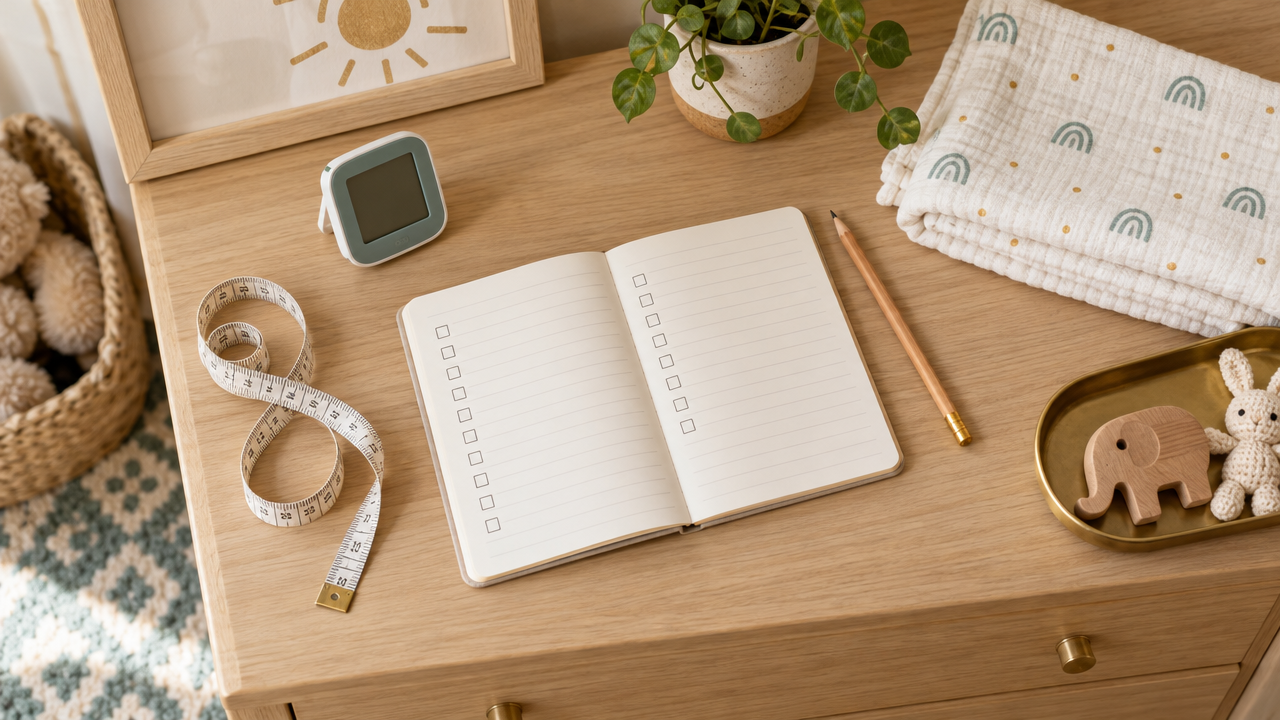
- Two thermometers. One near the crib, one next to the thermostat. Read both at 4 p.m., at bedtime, and at 2 a.m. A gap that opens in the afternoon points to sun; a gap that lasts all night points to the attic.
- Hand on the register. With the system running, compare the air from the nursery register with a downstairs one. A weak flow upstairs is a duct or balancing problem, not a capacity problem.
- Close the door. If the room gets warmer or stuffier with the door shut, the room has no good path for air to return to the system.
- Look up. If you can safely look into the attic, note how deep the insulation is and whether the ducts up there are crushed or disconnected.
Fixes that cost little or nothing
- Block the afternoon sun. Close blinds or blackout curtains on west and south windows by early afternoon, not at bedtime.
- Give air a way back. A door undercut or a transfer grille lets supply air actually flow through a closed room.
- Seal and insulate the attic. ENERGY STAR’s seal-and-insulate guidance is the starting point; in hot, sunny climates the Department of Energy also points to radiant barriers.
- Don’t just close vents downstairs. It rarely moves much air upstairs and can strain a ducted system. Have the airflow measured and balanced instead.
When the room needs its own control
If the cheap fixes don’t close the gap, the honest answer is that one thermostat can’t run two different rooms. A single-zone ductless mini split gives the nursery its own setpoint, and an inverter unit slows down as the room cools instead of switching on and off, which keeps the overnight temperature steady.
Sizing matters more than people expect: a nursery is usually smaller than the smallest standard unit, so the spec that decides comfort is how low the unit can turn down. See what size mini split a child’s room needs, how a mini split compares with a window unit, and what one costs for a single room in Los Angeles. For the target itself, see what temperature a baby’s room should be.
How Little Lungs handles the upstairs room
On a Free Air Check we read temperature and humidity at crib height against the thermostat, check the airflow into the room and the path back out, and look at what’s above the ceiling. Then we tell you plainly whether blinds and balancing will do it, or whether the room needs its own system.
Questions parents ask
Why is my upstairs bedroom hotter than downstairs?
Three things stack up: warm air rises inside the house, the roof and attic absorb the afternoon sun and keep releasing heat into the rooms below after sunset, and a single thermostat downstairs stops the system once the lower floor is comfortable.
Will closing vents downstairs cool the upstairs?
Rarely by much, and closing too many registers can strain a ducted system. It is better to have the airflow to each room measured and balanced, or to give the upstairs room its own small system.
What is the best way to cool one hot upstairs room?
Start with the cheap fixes: blinds on west and south glass, a clear return-air path, and a look at attic insulation and air sealing. If the room still overheats, a single-zone ductless mini split sized to that room lets it run its own temperature without changing the rest of the house.
Find out why your upstairs room runs hot
We measure the nursery against the thermostat and tell you which fix it actually needs.
Sources
- U.S. Department of Energy — Radiant Barriers
- ENERGY STAR — Seal and Insulate
- ENERGY STAR — Room Air Conditioners (sizing and humidity)