
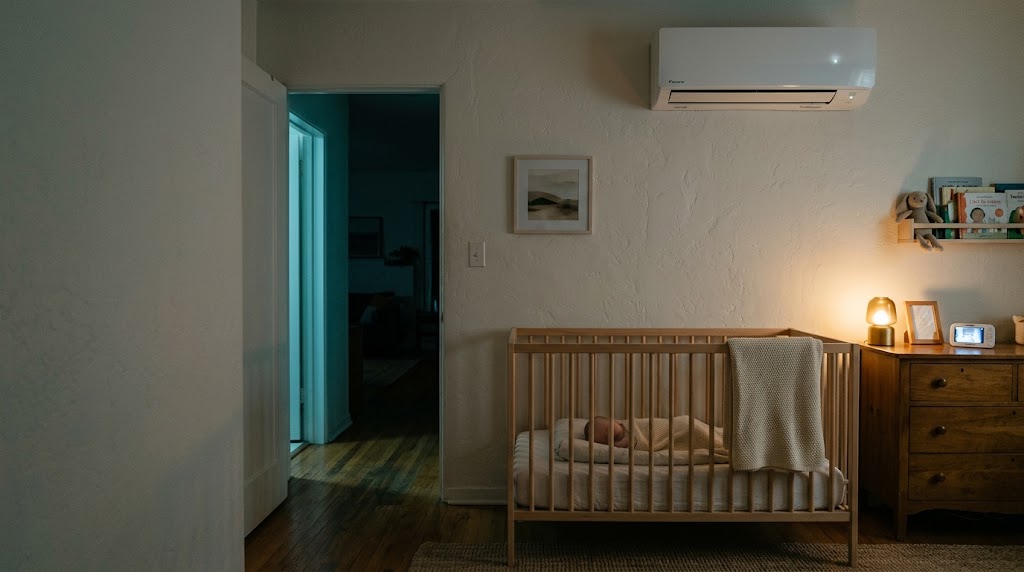
A mini split moves heat between an outdoor unit and an indoor unit through a refrigerant line — no ducts, and the same machine heats in winter.
That is the answer most guides give, and it is correct. It is also not the question a parent is asking. The question is whether a mini split will keep one specific room — the one with the crib in it — quiet and steady at 2 a.m., and whether that room should share an outdoor unit with the rest of the house or have its own. This guide covers both: how the equipment works, then the one decision that decides how it behaves in a child’s room.
Key takeaways
- Yes, mini splits heat and cool. They are heat pumps. The refrigerant cycle simply runs in reverse for heating, which is why one wall unit covers a Los Angeles nursery in both January and September.
- The inverter is what makes them quiet. Instead of switching on and off, the compressor slows down to hold the setpoint. Steady output is what a sleeping child needs; a conventional system that cycles is what wakes them.
- Single-zone vs multi-zone is a nursery decision, not just a house decision. A small bedroom head running alone on a large multi-zone outdoor unit at night is the one scenario where a mini split can cycle — in exactly the room where you can least afford it.
- Sizing comes from a Manual J load calculation for that room. An oversized unit cools fast, shuts off and leaves the room damp. The right size runs slow and steady.
- Where the indoor head goes matters as much as which one. Supply air runs parallel to the crib, never across it, and the outdoor unit does not sit under the child’s window.
How a mini split works, in four parts
A ductless mini split is a heat pump with the two halves of the system split between outdoors and indoors. Four components do all the work:
- Outdoor unit. Holds the compressor and a coil. In cooling mode it dumps the room’s heat outside; in heating mode it pulls heat out of the outdoor air, even on a cold morning, and sends it in.
- Indoor unit (the “head”). A fan and a second coil, mounted on a wall, a ceiling, or low on the floor. Room air passes over the coil and comes back cooler or warmer.
- Line set. Two small copper lines plus a control cable, running through a hole roughly three inches across. This is the whole reason no ductwork is needed.
- Inverter compressor. A variable-speed motor that matches output to the room’s load. When the room is close to the setpoint, it slows down rather than stopping. That is the part that decides whether the room is steady or swings.
Definition — heat pump: a system that moves heat rather than making it. In cooling mode it moves heat out of the room; in heating mode it moves heat into the room. Every ductless mini split sold for a bedroom today is a heat pump, which is why the answer to “do mini splits heat and cool” is yes.
In a child’s room the inverter is the feature that matters most. A conventional central system runs at full output until the thermostat is satisfied, shuts off, and starts again when the hallway warms up — and the nursery rides that wave, often two or three degrees either side of the setpoint. An inverter head sized for the room settles into a low, continuous hum and holds the number. That hum, on a wall-mounted Mitsubishi Electric unit in its quiet setting, is rated by the manufacturer in the high teens to low twenties dB(A) at the unit — quieter than a whisper, and well below a window air conditioner.
Single-zone or multi-zone: the decision that changes the nursery
The equipment inside a single-zone and a multi-zone system is identical. The difference is grouping: a single-zone puts one indoor head on its own outdoor unit; a multi-zone runs two or more heads off one outdoor unit, each with its own thermostat. For a whole-house retrofit of a ductless Spanish bungalow, multi-zone is usually the right answer. For the room a baby sleeps in, it depends on what the rest of the house is doing at night.
| What matters in a child’s room | Single-zone (its own outdoor unit) | Multi-zone (shares an outdoor unit) |
|---|---|---|
| Steadiness at night when other rooms are off | Highest. The unit is sized for this room and runs in the middle of its range. | Depends. A multi-zone outdoor unit has a minimum output it cannot go below. One small nursery head alone can sit under that floor and cycle. |
| Heat in the nursery while cooling elsewhere | Yes — it is a separate system. | No on standard multi-zones; every head runs in the same mode at the same time. |
| If the outdoor unit fails | Only this room is affected. | Every room on that outdoor unit loses service. |
| Electrical | Many 9,000–12,000 BTU models run on a 115V circuit — often no panel upgrade. | 230V dedicated circuit. |
| Exterior equipment | One more outdoor unit to place — and to keep away from the child’s window. | One outdoor unit for the whole house; easier with HOA or coastal rules. |
| Best fit | A nursery added to a house that already has central air; a converted office or guest room; an upstairs room that never cools. | A home with no ducts where three or more bedrooms will run together most nights. |
Minimum output, head count and line-set limits differ by model. Mitsubishi Electric’s largest MXZ outdoor units support up to eight heads; most multi-zone outdoor units from Mitsubishi Electric and Daikin support two to five.
The “lonely head” problem, explained
Picture a four-zone system installed for a family home in Torrance: living room, primary bedroom, a teenager’s room and the nursery. At 9 p.m. the living room head goes off. By 11 the teenager’s room is off. For the next eight hours the only head calling is the 9,000 BTU unit in the nursery, on an outdoor unit rated for four rooms. The outdoor unit cannot throttle low enough to match that one small load, so it does the thing a mini split is supposed to avoid: it overshoots, stops, waits, and starts again. The room drifts. The compressor restarts behind the wall. That is a design problem, not an equipment problem, and it is why the nursery sometimes gets its own single-zone even in a house that has a multi-zone for everything else.
Why sizing is the whole game
Mini splits are sized from a load calculation, not from square footage. ACCA Manual J accounts for the room’s orientation, window area, insulation, the floor above or below it, and the number of people in it — and a nursery with one sleeping infant and a west-facing window in Redondo Beach has a very different load from a south-facing office of the same size. Sizing to the calculation keeps the inverter in its efficient, quiet band. Oversizing by even one step up does three things parents notice: the room cools quickly and then the unit idles, humidity stays high because the coil never runs long enough to wring it out, and the on-off pattern returns.
Three placement rules come out of the same calculation:
- Supply air runs past the crib, not onto it. The head goes on a wall where the airflow travels parallel to where the child sleeps.
- The outdoor unit goes where the child’s window is not directly above it. Even a quiet condenser is quieter on the far side of the house.
- The factory filter is a pre-filter. If dust is the complaint, the room needs real filtration sized to its volume, and in California only CARB-certified air cleaning devices may be sold.
How Little Lungs does this
We treat the child’s room as its own project, whether or not the rest of the house is getting a system.
-
Assess
We measure the room — size, sun, insulation, existing HVAC, humidity, and the sound level at the crib position — and run a Manual J load calculation for that one room. If the house already has a multi-zone, we check whether the nursery load sits above that outdoor unit’s minimum output.
-
Optimize
We decide single-zone or multi-zone for the nursery based on what the rest of the house does at night, specify the Mitsubishi Electric head and outdoor unit for the calculated load, and set placement so the air never crosses the crib.
-
Certify
After installation we re-measure the same conditions we measured at the start and give you the before-and-after in writing.
Planning the whole house, not just the nursery? Our sister company, Dr. Ductless Heating & Cooling, covers multi-zone vs single-zone for garages, ADUs and whole-home retrofits across Los Angeles. And if you are buying a home where a previous owner already put a mini split in the room that will become the nursery, HVAC Inspections Los Angeles can check the system before escrow closes. Dr. Ductless and HVAC Inspections Los Angeles share ownership with Little Lungs.
Questions parents ask about mini splits
Do mini splits heat and cool?
Yes. A ductless mini split is a heat pump: the same refrigerant cycle runs one direction to cool and the other to heat. For a Los Angeles child’s room that means one wall unit handles a 58°F marine-layer morning and a 95°F October afternoon.
Are mini splits meant to run 24/7?
An inverter mini split is designed to run continuously at low speed rather than switch on and off. In a nursery that is the point: steady output is quieter and holds the temperature better than cycling. Turning it off and on each night costs more energy than leaving it to idle.
Can I plug a mini split into a regular outlet?
No — a mini split needs its own circuit. Many 9,000–12,000 BTU single-zone units run on 115V, which often avoids a panel upgrade on older South Bay homes with 100-amp service, but the circuit is still dedicated and the work is permitted. Multi-zone systems need 230V.
Why is my electric bill high with a mini split?
The usual causes are an oversized unit that cycles, a multi-zone outdoor unit serving one small head most of the day, a dirty pre-filter, or the system being switched off and on instead of left to idle. A correctly sized single-zone running steadily is the least expensive way to condition one room.
What are the disadvantages of a mini split in a nursery?
Three to plan for: the indoor head is visible on the wall; placement is constrained by line-set length and the need to keep air off the crib; and on a multi-zone, the nursery shares a mode and an outdoor unit with every other room. A single-zone removes the third one.
Will a mini split heat a nursery in a Los Angeles winter?
Yes. Los Angeles winter lows rarely fall below the range where a modern inverter heat pump loses capacity, and cold-climate models such as Mitsubishi Electric’s Hyper-Heating units hold rated output far below anything the coast sees. The more common problem is the opposite: a nursery that overheats on a sunny January afternoon, which the same unit handles.
Sources
- U.S. Department of Energy, Energy Saver — Ductless Mini-Split Heat Pumps
- ENERGY STAR — Ductless Heating & Cooling
- Mitsubishi Electric Trane HVAC US — What is a mini-split?
- Air Conditioning Contractors of America — ACCA Manual J Residential Load Calculation
- California Air Resources Board — California Certified Air Cleaning Devices
Not sure if their room needs its own zone?
The Free Air Check measures the room, runs the load calculation and tells you plainly whether the nursery belongs on its own outdoor unit — no cost, no obligation.
Get Your Free Air Check
Serving the South Bay, Westside and Beverly Hills.